

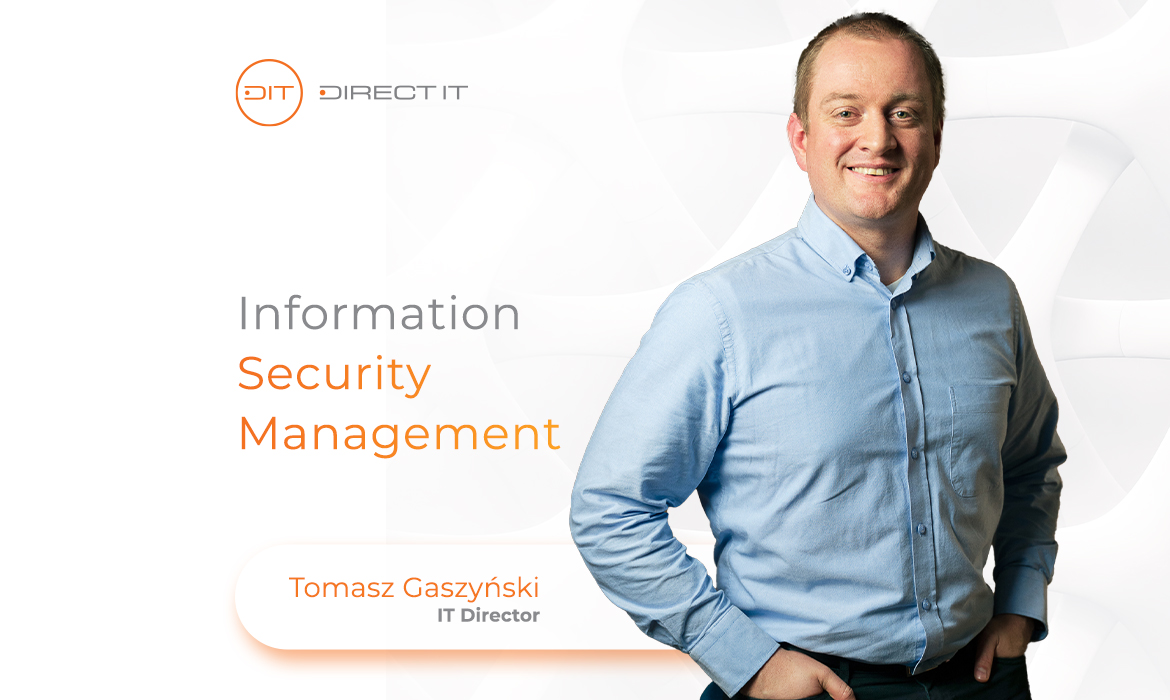
The author of the article Information Security Management is our expert, Tomasz Gaszyński, IT Director at Direct IT. In many companies, the topic of security is still approached too narrowly. It is most often reduced to hardware, systems, passwords, backups, firewalls, or monitoring. These are, of course, important elements, but they do not constitute security on their own. They can help, and sometimes they are even essential, but they do not solve the entire issue.
True information security management begins only when an organization takes a broader perspective. Not just technology, but also people, processes, responsibilities, decision-making methods, and everyday operational practices. Only the combination of these elements provides real protection, rather than just the illusion that everything is under control.
In an era of a growing number of cyber threats and increasingly complex IT infrastructure, information and data security has become a key element of business operations. The Polish Act on the National Cybersecurity System (KSC) imposes obligations not only on IT departments but also on the management of an entity, including the management board or individuals performing managerial functions. One of the key requirements is the annual training of the management body in the scope of KSC.
Email security is one of the most important issues today for both private users and businesses. For many people in Poland, an inbox on Onet, WP.pl, O2.pl, or Interia serves as the primary communication channel, and for companies, it is the hub for exchanging information and documents. Unfortunately, the popularity of email also comes with increasing threats: phishing, malware, password theft, and account takeovers. Experts at Direct IT in Poznań share tips on how to effectively secure your inbox, regardless of the service you use.
Poland is entering a new stage of building the digital resilience of the state and the economy. Karol Nawrocki has signed the amendment to the National Cybersecurity System Act, which implements the EU NIS2 Directive. The new regulations will come into effect as early as April and will significantly expand the scope of cybersecurity obligations.
Cybersecurity has become one of the key challenges for small and medium-sized enterprises (SMEs). The growing number of cyberattacks, increasingly stringent regulations, and the widespread digitalization of business processes mean that investments in IT system protection are no longer optional, but essential. At the same time, many SMEs are concerned about the costs associated with implementing advanced security solutions. In this context, European Union funds provide real support, enabling companies to co-finance cybersecurity projects without placing excessive strain on their budgets.
Backups are widely regarded as the foundation of data security in organizations. Many companies assume that if backups are performed regularly, data can always be restored in the event of a failure, ransomware attack, or human error. In practice, however, there are backups that simply cannot be restored. Corrupted files, incompatible system versions, configuration errors, or the lack of proper testing procedures often mean that, at the critical moment, backups turn out to be an illusion of security. As a result, the key question is no longer “Do we have backups?” but rather “Can we actually restore them when it matters?”
Modern companies increasingly use cloud solutions for data storage and backup. The cloud offers flexibility, scalability, and the ability to quickly restore information in case of failure, yet many myths have developed around its security. One of the most common is the belief that storing backups in the cloud automatically entails the risk of data leakage outside the organization. In reality, the truth is more nuanced – data security depends on technology, procedures, and responsible cloud management policies.
In the digital world where every company bases its operations on data, information security becomes one of the most important elements of business strategy. Data loss – whether resulting from ransomware attacks, employee errors, hardware failures, or natural disasters – can paralyze business operations for many days. Therefore, more and more organizations are choosing Acronis Cyber Protect solutions that combine backup, antivirus protection, and modern cybersecurity mechanisms in one tool.

